
Santé Arménie Medical Academy – Educational Activities 2025
Overview
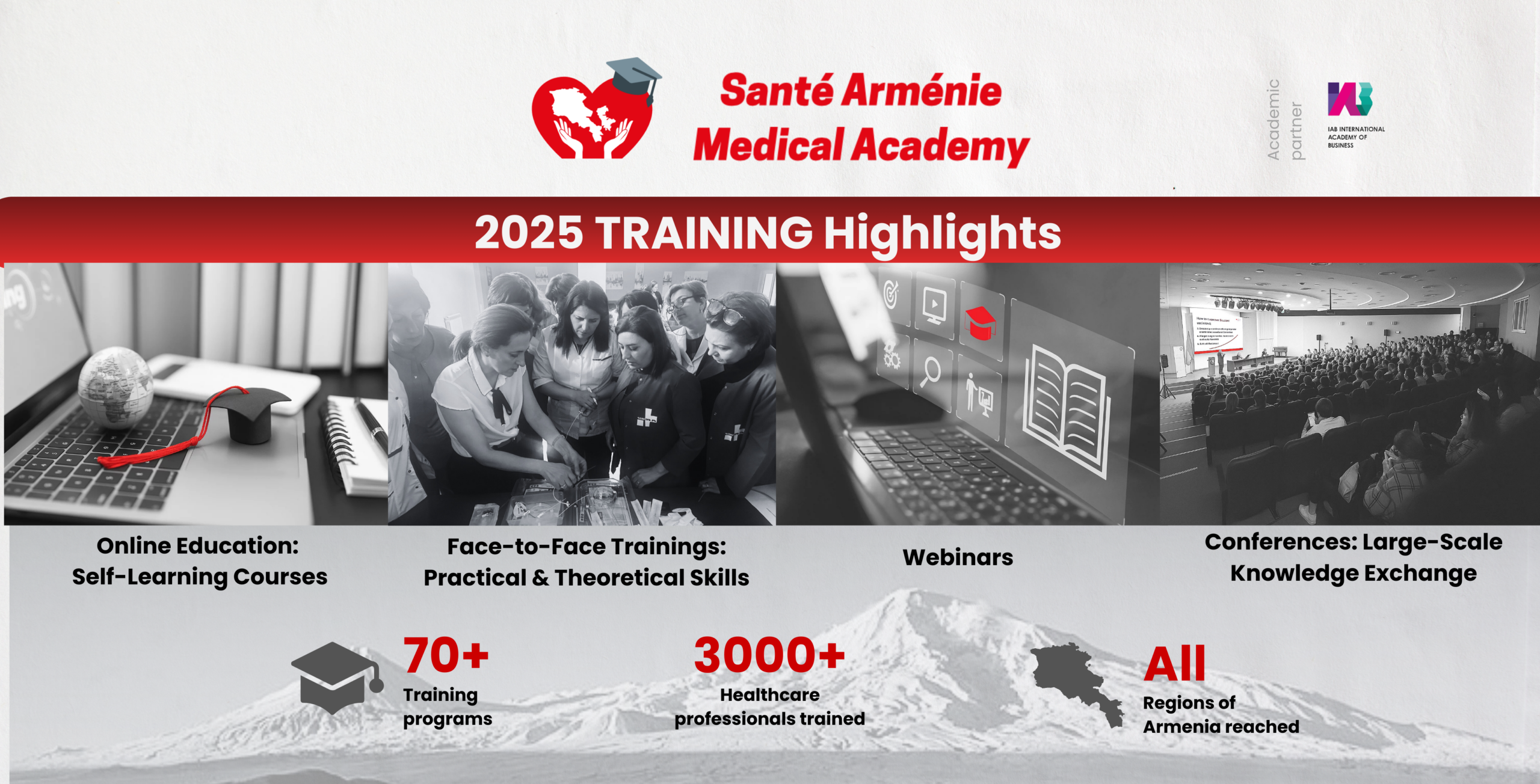
In 2025, Santé Arménie Medical Academy (SAMA) delivered a comprehensive, nationwide educational program aimed at strengthening the competencies of healthcare professionals across Armenia. Through online learning, webinars, hands-on regional trainings, and large-scale conferences, SAMA ensured accessible, practice-oriented, and evidence-based education aligned with international standards.
Data-Driven Impact Summary
- Total educational activities: 70+
- Total trained specialists: 3.000+
- Training formats: Online (Moodle), Webinars, Face-to-Face Trainings, Conferences
- Regions covered: Yerevan, Gyumri, Syunik (Sisian, Goris, Kapan, Meghri), All the Marzes of Armenia
- Target groups: Family doctors, therapists, cardiologists, pulmonologists, emergency and intensive care specialists, surgeons, pediatricians, ambulance drivers, researchers and scientists, Nurses, nursing students.
Online Education: Self-Learning Courses
Why this format matters
Our platform’s self-learning courses play a critical role in ensuring equal access to continuing medical education across Armenia. This format allows healthcare professionals to learn at their own pace, combine training with clinical duties, and revisit complex material when needed. For regional specialists and nurses working in shift-based systems, asynchronous learning is often the only sustainable way to maintain professional development while ensuring uninterrupted patient care.
Main topics covered
The 2025 Moodle portfolio focused on high-impact clinical competencies:
- Nursing practice and patient safety, based on recordings from the Armenian–French Nursing Conference
- Intensive Care Unit (ICU) patient management, including monitoring, nursing interventions, and safety principles
- Mechanical ventilation, with emphasis on respiratory physiology, ventilator modes, and complication prevention
- Emergency medicine fundamentals, including initial assessment
- Hemodynamics, focusing on circulation, shock states, and clinical decision-making
Trainers and acknowledgements
SAMA extends its sincere gratitude to the experts who voluntarily contributed their knowledge and time to these online programs:
- Gayane Khachaturyan-Hovhanisyan, for her leadership in nursing education and ICU-related courses
- Guillaume Hekimian, for delivering advanced content on mechanical ventilation and hemodynamics
- Tifenn Boisseau and Guillaume Der-Sahakian, for creating the emergency medicine training
A total of approximately 550 healthcare professionals completed Moodle-based courses, earning between 2 and 7 CME credits. Nurses constituted the majority of participants, reflecting SAMA’s strategic emphasis on strengthening nursing capacity through flexible, evidence-based digital education.
Webinar
Why this format matters
Webinars provide real-time interaction with experts while remaining accessible to participants across the country. This format enables rapid knowledge dissemination, discussion of updated international guidelines, and structured thematic learning without the logistical barriers of travel. Webinars are particularly effective for guideline updates, chronic disease management, and theoretical reinforcement of clinical practice.
Main topics covered
In 2025, webinar programs addressed a wide range of priority health topics:
- Nursing care and patient safety, including pain management, hygiene, asepsis, and professional communication
- Cardiovascular diseases and diabetes, delivered as a six-part structured series for family doctors and therapists
- Pulmonology, including spirometry performance and interpretation
- International clinical guidelines, with large-scale discussions on ESC 2024 recommendations for hypertension, atrial fibrillation, and chronic coronary syndromes
Trainers and acknowledgements
These webinars were made possible through the voluntary engagement of distinguished national and international experts:
- Gayane Khachaturyan, Marie Sarian for nursing-focused education
- Tatevik Bazinyan, Shake Bakhshyan, Leda Cilacian, and Krikor Balabanian for the comprehensive cardiovascular and diabetes series for family doctors
- Alec Vahanian and Hamlet Hayrapetyan, for national-level discussions on ESC guidelines for cardiologists. All the recordings of the webinars you can find on our website with this link.
- Artur Yessayan, for expert-led pulmonology education
More than 1,100 participants took part in SAMA webinars, including family doctors, therapists, cardiologists, and pulmonologists, nursing students, nurses. High-attendance ESC guideline discussions demonstrated the strong national demand for up-to-date, expert-led clinical guidance.
Face-to-Face Trainings
Why this format matters
Face-to-face training remains essential for developing hands-on clinical skills that cannot be fully acquired through online education. Simulation, supervised practice, and team-based exercises allow participants to translate theory into action, improve technical proficiency, and strengthen interdisciplinary collaboration. Regional delivery further ensures that high-quality training reaches healthcare teams outside the capital.
Main topics covered
In 2025, in-person trainings focused on critical, skill-intensive areas:
- Emergency and trauma care, including ABCDE methodology, anaphylaxis, cardiopulmonary arrest, and Advanced Trauma Life Support (ATLS)
- Pediatric and neonatal life support, emphasizing resuscitation, stabilization, and team coordination
- Respiratory emergencies, covering adult respiratory distress and airway management
- Ultrasound-guided procedures, including pleuropulmonary ultrasound and thoracic drainage
- Pain management and dialysis care, with strong focus on nursing practice and patient safety
- Prehospital care, including first aid and ambulance team training for nurses and drivers
Trainers and acknowledgements
SAMA expresses deep appreciation to the trainers who volunteered their expertise and time across Armenia’s regions:
- Tifenn Boisseau and Guillaume Der-Sahakian, for leadership in emergency, trauma, and ATLS trainings
- Dr Artur Sharluyan, for pediatric and neonatal life support programs
- Dr Artur Yessayan, for advanced respiratory and ultrasound-guided procedural trainings
- Sandra Testard, for prehospital and ambulance team education
- Gayane Khachaturyan, Natasha Guiignard and Marie Sarian, for nursing-focused clinical trainings
In 2025, more than 550 healthcare professionals participated in face-to-face trainings, benefiting from a balanced mix of theoretical instruction and practical, simulation-based learning delivered across multiple regions.
Conferences
Why this format matters
Conferences provide a unique platform for large-scale knowledge exchange, multidisciplinary dialogue, and international collaboration. They allow participants to engage with global experts, explore emerging scientific evidence, and align national practice with international standards. Conferences also foster professional networking and long-term capacity building.
Main topics covered
SAMA’s 2025 conferences addressed major public health and scientific priorities:
- Diabetes Mellitus, through the 3rd Armenian–French Nursing Conference series, focusing on patient-centered care, complications, and interdisciplinary management
- Pulmonology, addressing modern diagnostic and therapeutic challenges in respiratory medicine
- Immuno-Oncology, bringing together clinicians, researchers, and scientists to discuss immune-related mechanisms, biomarkers, translational research, and innovative cancer therapies
Trainers and acknowledgements
SAMA gratefully acknowledges the conference leaders and faculty whose voluntary engagement made these high-impact events possible:
- Gayane Khachaturyan, for leading the Armenian–French Nursing Conferences on Diabetes Mellitus
- Arsène Mekinian, for scientific leadership of the Pulmonology Conference
- Anna Martirosyan, for coordination and academic leadership of the International Summit on Immuno-Oncology
- International and national experts whose participation strengthened Armenia’s integration into global medical science
Conferences trained more than 850 specialists.
Conclusion
In 2025, Santé Arménie Medical Academy reaffirmed its mission to advance healthcare quality through comprehensive, accessible, and practice-oriented education. By training more than 3,000 healthcare professionals nationwide and fostering strong international collaboration, SAMA made a measurable contribution to professional development and patient care improvement in Armenia.

